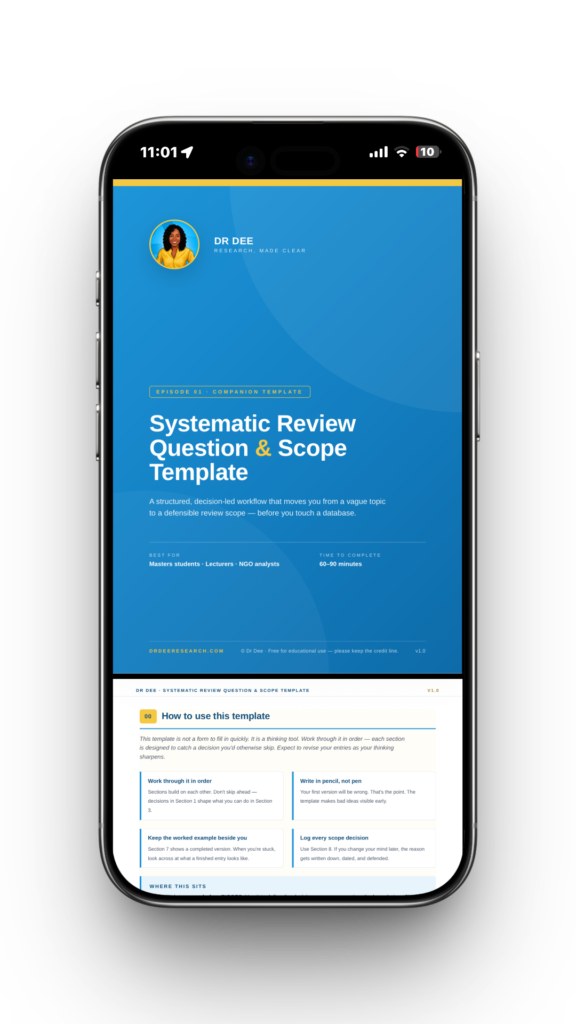

A structured, decision-led workflow that moves you from a vague topic to a defensible review scope — before you touch a database.
Most systematic reviews don’t fail in the screening or the synthesis. They fail in week one — because the question was never built to survive contact with real evidence. This template is the tool I give my own PhD students at the start of a review. It walks you through the decisions you can’t afford to skip: who the evidence is for, what’s in scope and what isn’t, and how to log every scope change so your review holds up under peer review.
Starting with a broad topic instead of a precise, answerable question.
Gathering evidence without knowing exactly who needs it to make decisions.
Forcing a systematic review when a scoping or rapid review was needed.
Failing to log scope changes, leaving the review vulnerable to peer-review rejection.
Clarifies who your review is actually for and what decisions it will inform.
Clearly defines what’s in, what’s out, and the explicit reason for each boundary.
Helps you choose between systematic, scoping, rapid, realist, or living reviews.
See the framework applied to a real-world global health research question.
A tracking system to protect you against peer-review challenges later.
The final checks you must pass before you move on to developing your PICOTS.
Research, Made Clear. Empowering students and analysts
with structured, defensible methodologies.
© 2026 Dr Dee. All rights reserved.